Section: Pest Prevention and Lawn Service Procedures
Subject: Irrigation Rate Card
Approved by: Adam Jones
Effective Date: 10 June 2016
Last Reviewed Date: 10 June 2016
Policy Owner: Irrigation Technical Training Director
Policy #
Objectives
This version of the Residential Irrigation Rate Card (see exhibits) has a new tool added to it called labor hours. This tool is to be used in three different ways to aid in the selling, execution, and managing of the irrigation service business:
- Scheduling
- The total hours for a single call can be used to schedule the work to be completed
- For service work that involves diagnostic services (troubleshooting), it is highly recommended to add time to the service call schedule in order to complete the repairs discovered during the diagnostic. This will prevent having to inconvenience the customer with a second or third service call and minimize drive time.
- Productivity Metric
- The hours quoted to complete the work can be compared to the actual hours spent in order to identify trends
- When actual hours consistently vary greatly from hours quoted, it may indicate the need for additional training of the sales person or the technician to ensure that the work required is identified correctly AND executed productively.
- Pricing Perspective
- To help a sales inspector understand the quoted price, it can be beneficial to put the price into perspective of the amount of time to complete the work in order to prevent the urge to discount the rate card price based on an inaccurate perspective.
The Policies
- The Residential Irrigation Rate Card is NOT to be used to quote commercial irrigation systems. The pricing is not correct to cover the scope and scale required to complete the work on commercial systems.
- DO NOT quote any repairs without first diagnosing the cause of the observed symptom(s) or malfunction.
- Any irrigation work that is not on an irrigation rate card MAY NOT be quoted without pre-approval by an irrigation Technical and Training team member (e.g. pumps, pump start relays, backflow preventers, new systems, major system alterations that affect hydraulics, any nozzle changes on pumps that change the flow by 20% or more, etc.).
- When determining the per-foot cost of trenching, if digging will be required within 2 times the diameter of any plant canopy, the “Trench and Backfill Roots or Rocks” rate shall be used.
- The hours per task and the total hour are for service center use only. These hours should never be given to the customer or prospect.
- This rate card is not to be left with any customer or prospect for any reason. It is also not recommended to show any customer or prospect the rate card as the hours may be misinterpreted.
The Process
- The inspector or other team member creating the proposal using the rate card shall also extend and total the labor hours required to conduct the work for each line and a total for all work on the quote.
- The inspector shall give the Customer Service Representative or Office Manager the total hours of the work sold when calling in to get the work scheduled.
- The technician shall be given a copy of the approved rate card with the other information for the job start.
- Should the technician encounter or observe any conditions that will prevent them from meeting the quoted man hours, they shall immediately notify the Service Manager or General Manager.
- The technician shall record the total actual hours spent completing the work on the copy of the approved rate card, in the space provided under to the total hours quoted (bottom center of page 2) and turn in with the daily White Sheets.
- The Service Manager shall review the total hours, actual vs. quoted, at the end of each day, as part of the daily check-in of the irrigation technician and investigate any significant differences THAT DAY.
- The General Manager shall be responsible to review all irrigation proposals in comparison of the actual work required to complete the work proposed to ensure the inspectors have adequate knowledge and skill to produce accurate proposals.
- The first recurring service shall be scheduled to take place approximately 30 days after the completion of the initial service work to provide an opportunity to “fine tune” the system to the changes made during the initial repair.
Any time repairs are made during periods of drought, a proactive service shall be scheduled to occur within 3 days after the repairs to go to the site and assess - the appearance and health of the plant material.
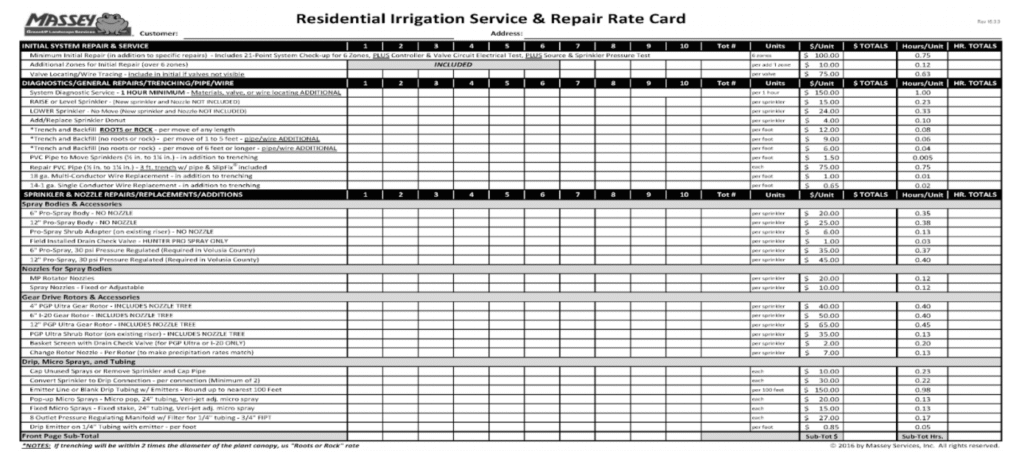
EXHIBIT A: Standard Residential Irrigation Rate Card – SIDE ONE 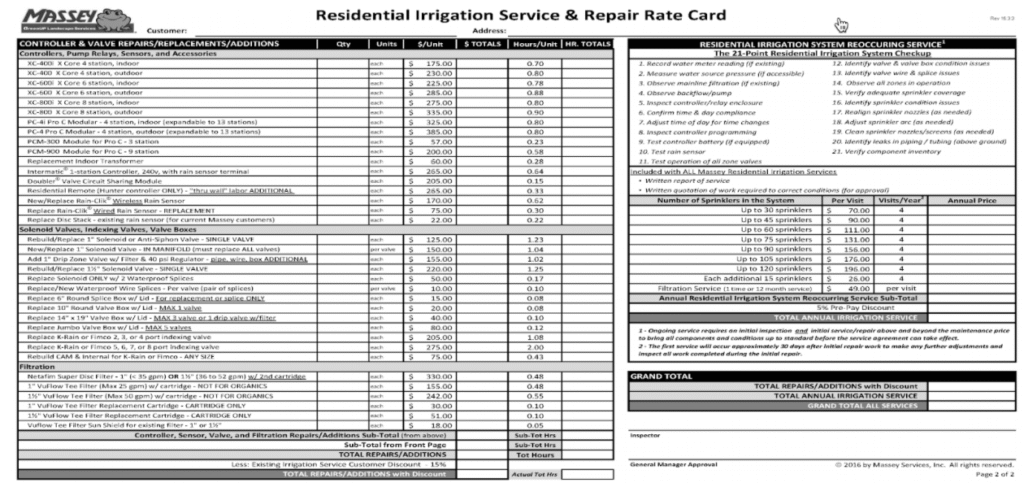
EXHIBIT B: Standard Residential Irrigation Rate Card – SIDE TWO 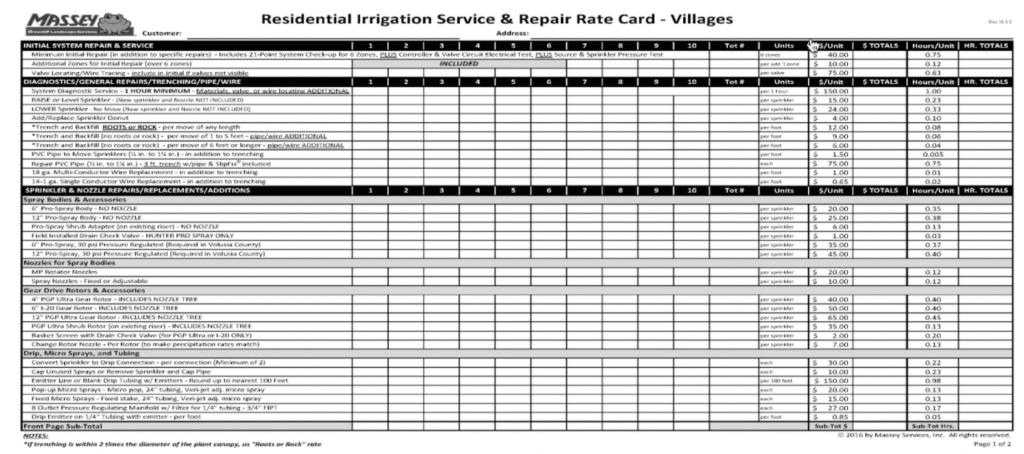
EXHIBIT C: Villages Residential Irrigation Rate Card – SIDE ONE 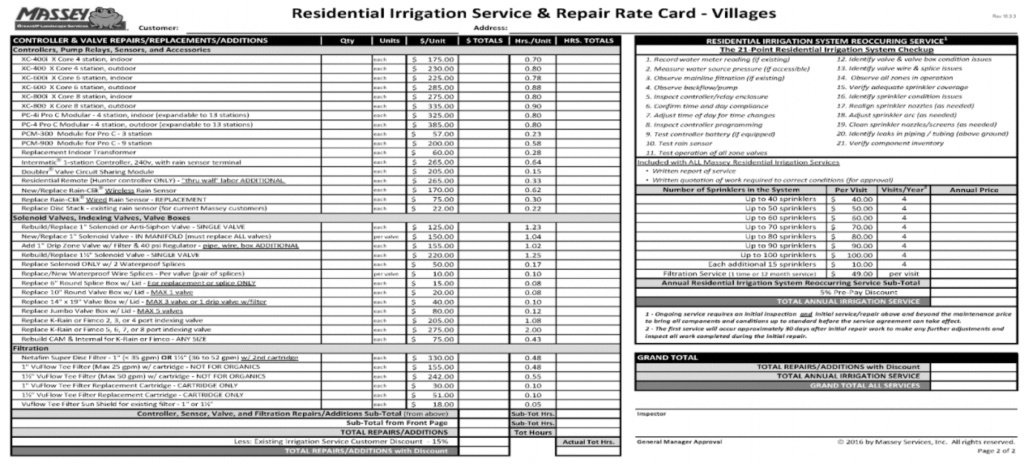
EXHIBIT D: Villages Residential Irrigation Rate Card – SIDE TWO