Section: Accounting
Subject: Fixed Assets, Capital Expense Reports
Approved by: Tony Massey
Effective Date: 14 November 2001
Last Reviewed Date: 13 April 2026
Policy Owner: Senior Director of Tax and Compliance
Policy #
Fixed Assets #
Fixed assets are long-lived assets, with a cost of $500 or more. Fixed assets are also referred to as capitalized expenditures. Because fixed assets have a relatively long period of expected service and a substantial cost, the costs are depreciated over the period of expected useful service. Fixed assets typically fall into one of the following categories:
- Equipment
- Leasehold improvements
- Software
- Vehicles
Equipment
Fixed assets include all treating equipment, office furniture, computers, and equipment with a cost of $500 or more (including sales tax). Treating equipment includes pumps, rotary hammer drills, fumigation tarps, etc. Office furniture and equipment includes desks, chairs, phone systems, and copy machines, that have a cost of $500 or more.
Leasehold Improvement
Leasehold improvements are any additions to existing leased facilities. To qualify for capitalized leasehold improvements, the expenditure must be an addition, rather than a repair, to leased facilities. Repairs to leased facilities such as touch-up painting, minor air conditioning repairs, and other miscellaneous minor repairs are expense items and are not recognized as leasehold improvements.
The cost of a leasehold improvement is normally amortized (depreciated) over the remaining life of the lease, not the expected life of the leasehold improvement. The Accounting department will determine the amortization schedule for each leasehold improvement.
Software
Software includes all purchased computer programs, operating systems, and application packages with a cost of $500 or more (including sales tax). To qualify as a capitalized software asset, the expenditure must be for a new software package or a significant upgrade that enhances functionality beyond routine maintenance. Minor updates, license renewals, subscription fees, and routine maintenance agreements are considered expense items and should not be capitalized.
Capitalized software is depreciated over its useful life, consistent with corporate fixed‑asset guidelines.
Examples of capitalizable software include, but are not limited to:
- New office productivity suites
- Specialized treatment, routing, or operational software
- Major system upgrades that provide substantially improved functionality
Examples of non‑capitalizable software expenses include:
- Anti‑virus subscription renewals
- Cloud‑based subscription licenses billed monthly or annually
- Routine software patches or maintenance updates
Vehicles
Vehicles include all automobiles, trucks, and specialized service vehicles. The cost of a vehicle includes the purchase price, applicable taxes, delivery charges, and any required initial accessories necessary for operational readiness (such as equipment or decals).
Vehicles are depreciated over their assigned useful life, consistent with corporate fixed‑asset guidelines. Routine maintenance, repairs, fuel, detailing, and other operating expenses are not capitalized and should be charged as period expenses.
FIXED ASSET Approvals #
All fixed asset purchases must have the prior approvals as required by PP: C-4 Limits of Authority. Certain purchase types require additional approvals as shown in Table 1, below.
Table 1. Required Approvals by Purchase Type
| Purchase Type | Required Approvals: Service Center | Required Approvals: Corporate | Additional Approvals as required by PP C-4 Limits of Authority |
| Equipment | General Manager | Department Director/Manager | Regional Manager, Regional Vice President, Vice President, Chief Financial Officer, CEO & President |
| Leasehold Improvements | General Manager, Regional Manager, Regional Vice President | Department Director/Manager | Vice President, Chief Financial Officer, CEO & President |
| Software | General Manager, Regional Manager, Regional Vice President, IT Director, VP of IT | Department Director/Manager, IT Director, VP of IT | Vice President, Chief Financial Officer, CEO & President |
| Vehicles | Director of Fleet Management, Regional Manager, Regional Vice President, Vice President of Fleet & Assets, Chief Financial Officer, CEO & President | Department Director/Manager, Director of Fleet Management, Corporate Vice President, Vice President of Fleet & Assets, Chief Financial Officer, CEO & President |
Most treating equipment and vehicles will be handled at the time of budgets and should require the input of the Director of Quality Assurance and the Director of Fleet Management.
The CEO & President has final approval on all signage regardless of price.
CAPITAL EXPENDITURE REQUEST #
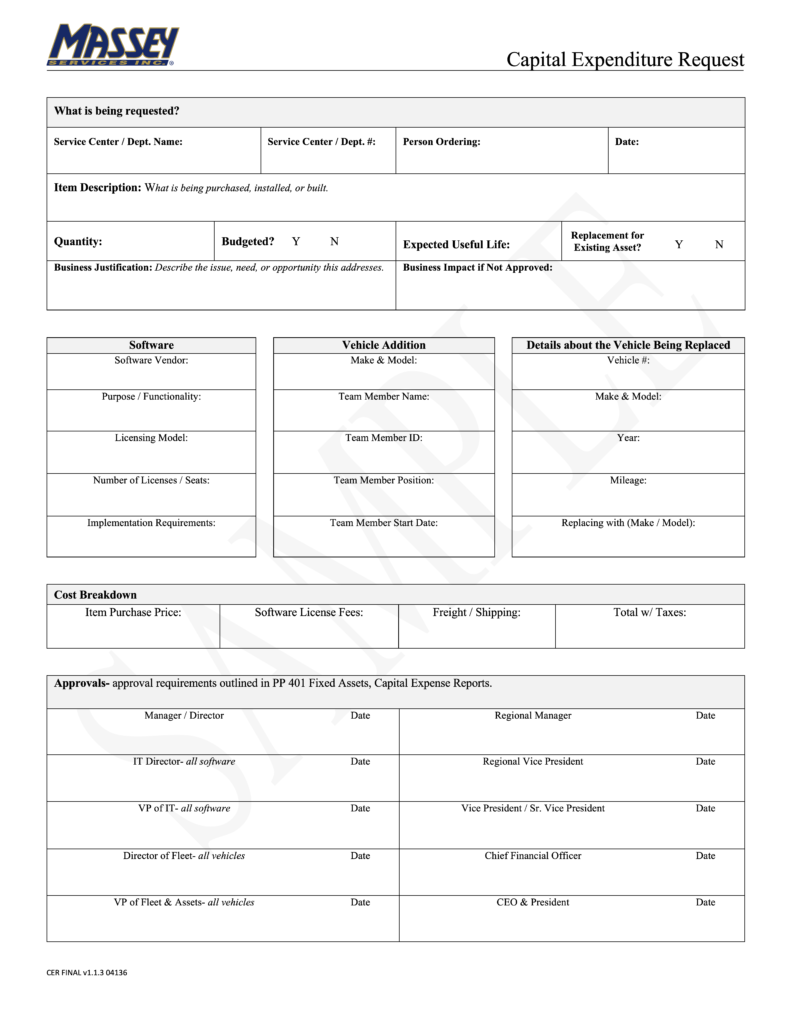
Before approval will be granted, the purchaser must complete and forward a “Capital Expenditure Request” for appropriate approvals (Appendix A).
The CER is a document used to order all capitalized items. The purchaser is responsible for submitting a CER for all fixed assets. Purchases which exceed the manager’s limit of authority must have prior approval.
Prior to originating a CER, the purchaser must determine that the request is essential. Other options that should be considered are:
- Repair inoperative equipment. (A good preventative maintenance program will decrease frequency of equipment failure and drive down the replacement costs.)
- Check with other service centers or departments on the availability of excess or surplus equipment and/or furniture. Before any new equipment is approved, an attempt to find and utilize any comparable surplus equipment must be made.
- Consider a short-term lease or rental of equipment as an alternative (where long-term revenue results may not be anticipated or seasonal situations may exist).
All CER’s must be approved and signed by the originating purchaser and all required approvers. The CER shall contain the total cost of the item(s) with a proper detailed explanation and justification as to the necessity of the purchase. Any applicable estimate of bids, drawings, photos, etc., should also be attached.
Completed CER’s shall be forwarded to the appropriate approval authority for signature. Verbal approval may be given in an emergency, but the signed CER must be attached to the invoice or requisition before Accounting will process payment.
Fixed Asset Inventory #
The general manager or department director/manager is to inventory their fixed assets/capital equipment annually, when requested by corporate, or when assigned to a new service center or department. The inventory is to be recorded on the Depreciation Schedule. All capital equipment items are listed by make, model, serial number, approximate age, and condition. A copy is forwarded to Accounting for verification of items and a copy must be retained at the service center/department for future reference.
FIXED ASSET DISPOSAL #
Prior to the disposal of any fixed asset (whether by sale, transfer, or scrap), the service center/department must complete a “Request for Disposition or Asset Transfer Form” and forward to Accounting. If the item is to be transferred to another service center or department, the depreciation expense will be transferred beginning on the effective date of the transfer.
If a fixed asset will be sold, approval is required based on the asset type and book value or loss. Specific requirements are listed in Table 2, below.
Table 2. Fixed Asset Disposal or Sale Required Approvals
| Asset Type | Service Center Asset | Corporate Asset Sale | Additional Approvals |
| Equipment | General Manager Regional Manager | Department Director | As required by PP C-4 Limits of Authority, based on asset book value or loss on disposal |
| Computer Hardware | General Manager Regional Manager IT Director VP of IT | Department DirectorIT Director VP of IT | As required by PP C-4 Limits of Authority, based on asset book value or loss on disposal |
| Vehicles | Director of Fleet Management Regional ManagerRegional Vice President VP of Fleet & Assets | Department DirectorDirector of Fleet ManagementCorporate Vice President VP of Fleet & Assets | As required by PP C-4 Limits of Authority, based on asset book value or loss on disposal |
APPENDICES #
Appendix A: Capital Expenditure Request form