Introduction #
This Service Protocol covers treatment strategies for interior and exterior of customers including, but not limited to, Walgreens, CVS and Family Dollar for insect and rodent issues.
Each service will include inspection and treatment of the interior and exterior of the structure.
Upon arrival, meet with the Manager on duty, discuss with them any issues they have observed since the last service. Do not perform any work until you met with the Manager. Begin the service with an inspection of the property searching for Conditions, Avenues and Sources of pest activity. The inspection of the property will include the interior of the structure, the exterior of the building (from the foundation out 10 feet) and the perimeter of the property (10 feet from the structure to the property line).
Perimeter #
- Inspect the perimeter of the property including the parking lot, parking lot islands, mulch beds, edge of property, dumpster area, etc.
- Fire ant activity
- Treat around mounds with Advion Fire Ant Bait.
- If fire ant activity is observed on concrete/asphalt surfaces, follow fire ants back to mound and treat with Advion Fire Ant Bait.
- Fire ants found on dumpster or mounds found in expansion joints can be treated with Temprid.
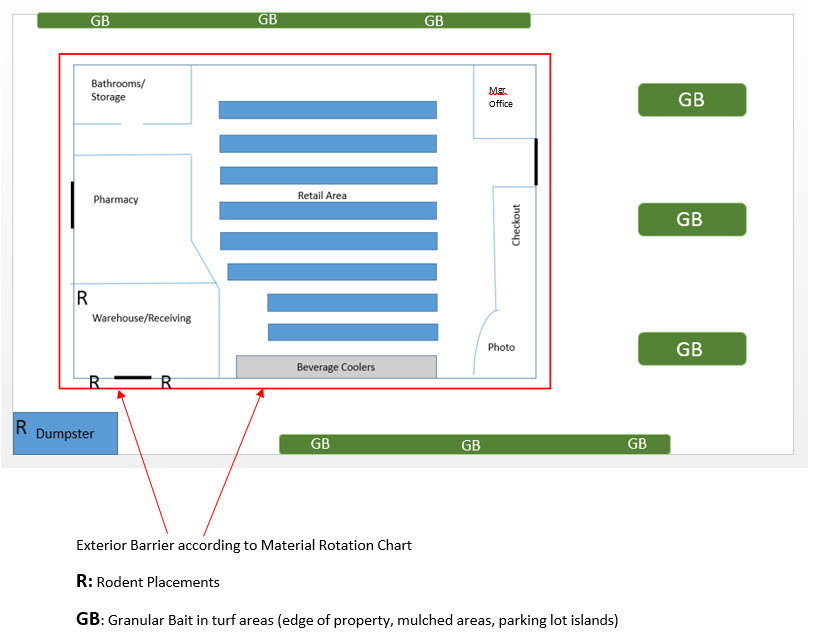
- Roach and other crawling insect activity- apply either Intice Granular Bait or Advion Insect Granular Bait, depending on Material Rotation Chart, to mulched areas.
- Fire ant activity
Exterior #
- Insect Activity
- Inspect the exterior of the structure.
- Use Webster brush to remove spider webs, wasp nests and mud dauber nests from the front door area, windows, and drive thru pharmacy area (if present).
- Treatment of structure/foundation interface
- Apply exterior barrier materials according to the Material Rotation Chart
- Liquid barrier applications are to be applied 1-foot up and 1-foot out from the foundation
- When liquid barriers are not the primary material for the month, they are to be used as spot applications directly to trailing insects.
- Granular residual materials are to be used in turf areas up to 10-feet away from the structure in a 2 to 5 foot barrier around the structure.
- If concrete abuts up against foundation, do not use granular products. Make spot applications with Temprid to points of entry (doors, windows, etc.)
- Apply exterior barrier materials according to the Material Rotation Chart
- Apply liquid crack and crevice materials, according to Material Rotation Chart, between building walls and sidewalks on paved areas.
- Spot treat pharmacy drive-thru as required.
- Rodent Activity
- Place one Protecta Evo Express Rodent Bait station (containing the concrete block)
- inside the dumpster area
- against back wall of the structure near the service entrance
- If rodent activity is high or exterior conditions are conducive to rodent activity, place bait stations every 15-20 feet around the foundation of the structure.
- All rodenticide bait is to be secured on rods inside the bait station
- Service log sticker must be inside, dated with service date and attached to the interior of the bait station lid. Initial in the required area every month when rodent bait boxes are checked.
- Close the bait station and ensure the lid is locked and secure.
- Place one Protecta Evo Express Rodent Bait station (containing the concrete block)
Interior Insect #
Retail/Grocery Area
- Inspect the front counter, gondolas, beverage coolers, aisles with food items/pet food and pharmacy area.
- If roach activity is present,
- Make the appropriate gel bait applications based on the Material Rotation Chart only to voids and cracks and crevices.
- Do not apply in areas where people can see of come in contact with them.
- If ant activity is present,
- Spot treat trailing ants with Phantom.
- Go back and look for trailing on the exterior of the structure.
- Spot treat the entry points and treat nest with appropriate materials (if possible).
- Bait on the exterior where appropriate
- Place Insect Detection Traps (IDTs) as needed, but only place where they are completely hidden from public view.
Non-Retail Areas
- Inspect product storage areas, offices, bathrooms, etc.
- When insect activity is present, make crack and crevice treatments with products dictated by the Material Rotation Chart depending on the insect pests that are encountered.
- If insect bait is required, apply the products to shelving in a 3 dimensional pattern (up, down, back, front).
- If liquid ant bait is required, ensure that it is secured in an ant bait station.
- Apply either Intice Fine Granular Insect Bait or Advion Insect Granular Bait in void and mechanical areas as appropriate for crawling insect activity.
Interior Rodent #
- Inspect front counter, gondolas, aisles with food items (including pet food), warehouse where food is kept, etc. for travel paths, potential entry points and harborage areas throughout the structure. Inspect the back roll-up receiving door for entry points.
- Based on your findings, place snap traps and glue traps (DO NOT PLACE GLUE TRAPS IN CVS STORES) in protected/concealed areas in areas of rodent activity. Follow the Massey Services Rodent Protocol until all activity is eliminated.
- Use a HEPA filter vacuum to remove rodent droppings.
- Any confirmed rodent activity will require the scheduling of Proactive Follow-ups every 2 days until activity is eliminated (no activity for 3 consecutive follow-ups).
- Unless prior approval has been given by a member of the Quality Assurance Department, do not place rodenticide bait inside of the structure.
Document all activity, potential harborage areas, entry points, treatment performed, product usage, time in/time out, etc. on the Massey Services Commercial Service Report. In addition, communicate verbally with the Manager on duty your findings and efforts to eliminate potential and actual pest issues. Have the Manager on duty sign the Service Report and have them stamp it with the store stamp. Any significant pest pressure or sanitation issues must be reported to Service Center Management to determine follow-up needs.
Walgreens Specific Actions #
On initial services, place a Rodent Log Book in the Manager’s office. This will serve as a central record keeping point for rodent activity. Document all rodent activity observed on any service and continue to document it until activity ceases.
CVS Specific Actions #
Calling the CVS FIXX Line is only required for initial starts in new locations and CVS work orders related to extra service requests, not regular scheduled service. All extra service requests for CVS will be assigned a Work Order Number that is to be included on the Extra Service Report. Upon arrival at the location meet with the manager and provide them the Work Order #. After completing the corrective service meet the manager to review the service and sign the Service Report. The manager will provide a completion code which is to be written on the Service Report. Before leaving the unit the technician must call the CVS FIXX Line, go through the automated prompts submitting the Work Order # and Completion Code which closes the work order. All extra service requests must be closed by calling the CVS FIXX Line at the conclusion of the service.