INTRODUCTION #
Bats are essential to the health of our natural world. They help control pests and are vital pollinators and seed-dispensers for countless plants. Yet these wonderfully diverse and beneficial creatures are among the least studied and most misunderstood of animals.
Centuries of myths and misinformation still generate needless fears which threatens bats and their habitats around the world. Bat populations are declining almost everywhere. Losing bats would have devastating consequences for natural ecosystems and human economics. Bat Conservation International has been combining education, research and conservation to protect bats worldwide since 1982.
The more than 1200 species of bats (about 1/5th of all mammal species) are incredibly diverse. They range from the world’s smallest mammal, the tiny bumblebee bat that weighs less than a penny to the giant flying foxes with 6 foot wingspans. Except for the most extreme desert and polar region, bats have lived in almost every habitat on Earth since the age of the dinosaurs.
Bats are primary predators of night-flying insects, including many of the most damaging agricultural pests and others that bedevil the rest of us. More than 2/3rd of bat species hunt insects, and they have healthy appetites. A single little brown bat can eat up to 1,000 mosquito-sized insects in a single hour, while a pregnant or lactating female bat typically eats the equivalent of her entire body weight in insects each night.
Almost 1/3 of the world’s bats feed on the fruit or nectar of plants. In return for their meals, these bats are vital pollinators of countless plants (many of great economic value) and essential seed dispersers with major roles in regenerating rainforests. About 1% of bats eat fish, mice, frogs or other small vertebrates.
Only 3 species, all in Latin America, are vampires. They really do feed on blood, although they lap it like kittens rather than sucking it up as horror movies suggest. Even the vampires are useful; an enzyme in their saliva is among the most potent blood-clot dissolvers known and is used to treat human stroke victims.
APPEARANCE #
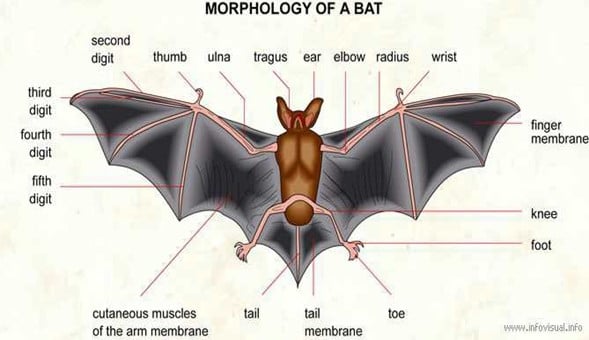
Bats belong to the order Chiroptera, which means “hand wing”. They are the only mammal that can truly fly. The Southeastern United States has around 13 different species of bats. Contrary to popular belief, bats are not blind. Their vision is adapted for low light levels. However, bats can maneuver in complete darkness by using echolocation. Echolocation is the use of sound waves to detect objects. Bats emit high-pitched sounds and listen for them to echo back. The length of time it takes the echo to return tells the bat how far away it is from an object. This allows the bat to fly in the dark and hunt for food. Bats’ feet are uniquely adapted for grasping structures so that they can rest while hanging upside down. Bats undergo a state of torpor (the dormant state of an animal) in the daytime, their heart rate and body temperature decrease so that they can conserve energy. Because of this, bats are reluctant to fly in the daytime even when disturbed. If they are forced to fly, they must first raise the body temperature and heart rate. For their size, bats have the longest lifespan of any mammal. Some can live for more than 30 years.
HABITAT #
Bats live in many different habitats across the Southeastern United States. They can be found from sand hills to the hardwood forests along the banks of rivers, and probably even in your neighborhood. For bats, one of the most important parts of their habitat is an area to roost. Some bats, like the Brazilian free-tailed bat, the evening bat, and the big brown bat are colonial, meaning they gather together in a colony to roost during the day. Other species, like the Seminole bat and the tri-colored bat, are solitary, meaning that they roost by themselves. In the Southeastern United States, natural roosting sites can be cracks, crevices, and hollows of trees, caves, dead fronds of palm trees, Spanish moss, and tree foliage. Bats also use manmade structures including buildings, bridges, culverts, tile roofs, and bat houses.
BEHAVIOR #
Native bats are insectivorous, meaning they eat insects including beetles, mosquitos, moths, and other agriculture and garden pests. In fact, bats are the most important controller of night flying insects because a single bat can eat hundreds of insects a night.
Bats mostly mate in the fall and winter. The female does not usually ovulate until the spring when the insect population increases, but she can retain sperm for months before ovulation occurs. Most female bats only have 1 pup per year. For their size, bats are the slowest reproducing mammals. Pregnant females of some species will gather together in nursey colonies. Bats do not build nests. They normally give birth from mid-April through July, and their young begin to fly within 3 to 6 weeks. Juveniles are then weaned from their mothers and by mid-August the young are able to forage and fly on their own. Bats will not reach reproductive maturity until they are about 1 year old. This is considerably longer than most small mammals.
BATS AND PEOPLE #
Bat populations are declining in many areas. The loss of roosting sites (such as trees and caves) can cause bats to roost in areas where they are most likely to be a nuisance for people. The use of pesticides to control insects can take away the food that bats eat, and sometimes poison the bats themselves. These unique mammals have been sensationalized in the news and horror movies, creating a great deal of anxiety among Americans. Fear of rabid bats has caused mass destruction of bat populations for decades even though they seldom pose public health problems. Ironically, this fear has caused more people to come in contact with bats while attempting to eradicate them. Rabies, a virus usually transmitted from a bite, affects a very small portion of the bat population in the Southeastern United States.
Histoplasmosis is a respiratory illness caused by a fungus. This fungus is found in soil that is enriched with bat or bird feces. This fungus is sometimes found in chicken farms or in caves. According to the Florida Bat Conservancy, “this illness has been associated with bats in Florida in only a few cases, all of which involved visits to bat caves”. Attics and roofs are normally dry areas that do not provide the proper conditions for the fungus to survive. For more information about bats and rabies or histoplasmosis, including what to do if a person makes contact with a bat, contact your county health department, the Florida Department of Health, or the CDC.
Bats, like many other wildlife species have been able to adapt to habitat loss by moving into manmade structures. Female bats of some species will roost in large colonies when they have pups. The potential of exterminating large numbers of bats at once means that the bat populations are particularly vulnerable to extirpation.
PROTECTING BATS #
It is illegal to kill bats in Florida in accordance with Florida Administrative Code number 68A-4.001 General Prohibitions and 68A-9.010 Taking Nuisance Wildlife. The use of pesticides or poisons for the purpose of harming, killing, or deterring bats is prohibited in the state of Florida. There is one legal registered repellent: naphthalene (moth balls). Unfortunately, moth balls are rarely effective or practical in repelling bats from a structure.
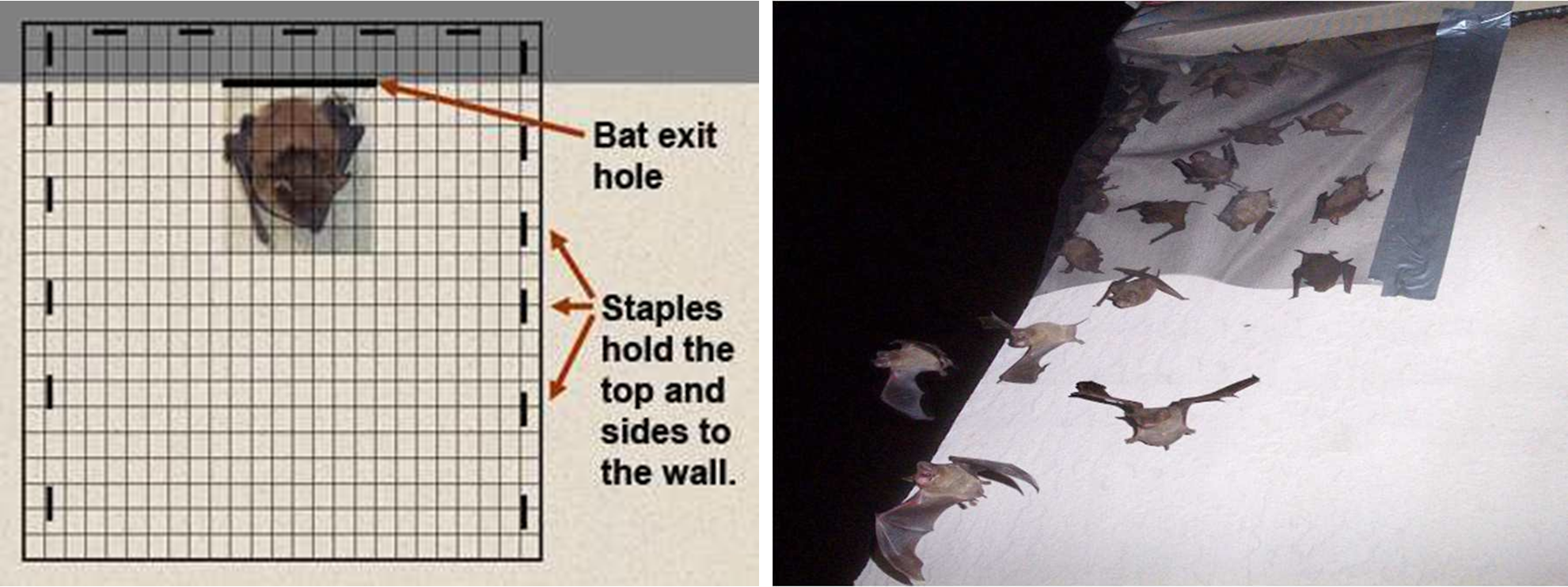
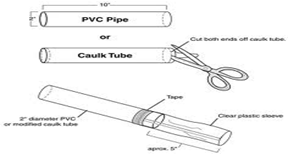
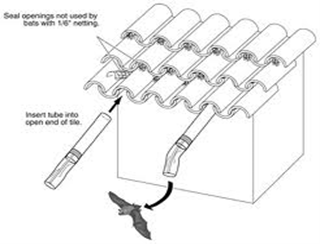
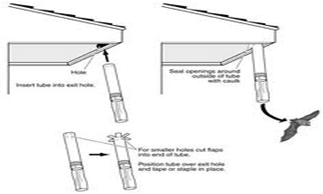
When bats take up residence in a structure where they are not wanted, the legal, safest, and most effective technique for getting rid of them is a process known as “exclusion”. Excluding bats from their roost sites involves the use of a one-way device which allows bats to exit the structure, but prevents them from re-entering. After the bats are gone, the device is removed and the entrance holes are sealed. Prior to excluding the bats, any other potential openings the bats might use should be sealed, including openings as narrow as
½ inch. Bat-proofing for most structures involves a few simple, energy-efficient home improvements such as applying caulking and weather stripping.
To ensure that all bats have exited, exclusion devices must be used for a minimum of 4 consecutive nights with temperature above 50 degrees. Because insect activity slows during cold weather, bats often become inactive and may not exit the structure.
In Florida, exclusions cannot be conducted between APRIL 16th and AUGUST 14th and in other states between April 15th and August 31st because when the mothers fly out of the structure and can’t return, they are separated from their flightless young, leaving the young bats trapped to die within the buildings.
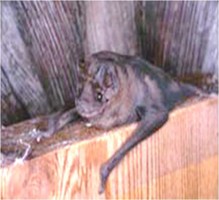 Velvety Free-tail Bat
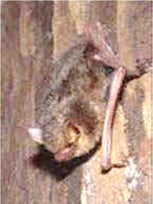 Tricolored Bat
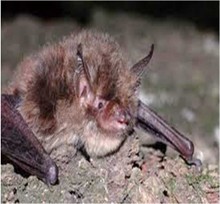 Southern Myotis Bat
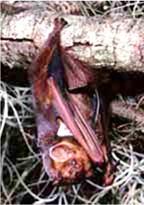 Seminole Bat
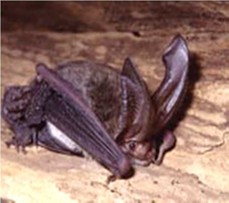 Rafinesque’s Big-eared Bat
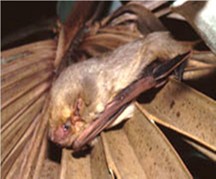 Northern Yellow Bat
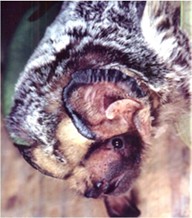 Hoary Bat
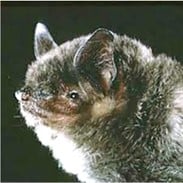 Gray Myotis Bat
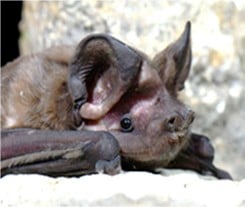 Florida Bonneted Bat
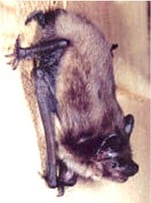 Evening Bat
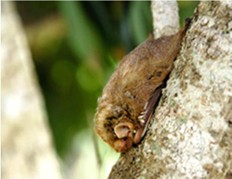 Eastern Red Bat
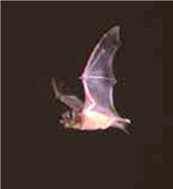 Brazilian Free-tailed Bat
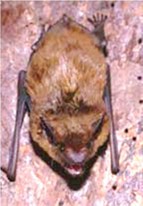 Brazilian Free-tailed Bat
HOW YOU CAN HELP PROTECT BATS #
- Avoid disturbing maternity colonies or entering caves where bats are roosting
- Never shoot, poison, or otherwise harm bats
- Be cautious when using insecticides
- Use caution when trimming trees and Spanish moss to avoid disturbing roosting bats
- Do not attempt to handle bats without supervision of a professional
- Bats are very delicate creatures and are easily injured if handled
- Handling bats increases the chance that you might be bitten
- Seek medical help if bitten by a bat
- Construct a Bat House
- Bats are so effective at controlling insects that some people attempt to attract bats with bat houses
- Bats are a very important natural resource, because each bat can eat hundreds of insects, including mosquitos and agriculture pest per night
- Bat guano (feces) has been used for centuries as a nutrient rich fertilizer and is still highly prized by gardeners
- Support Bat Conservation
Exclusion #
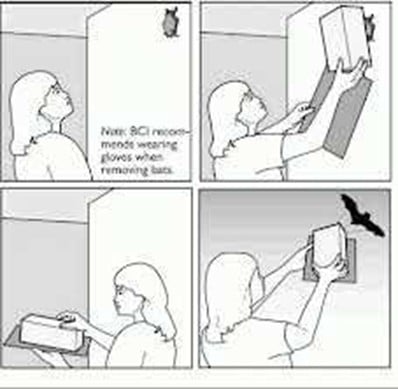
Capturing a Bat Indoors #