PERFORMING THE MOSQUITO INSPECTION #
To provide effective mosquito prevention, we must conduct a thorough inspection of the property and neighborhood before the first treatment. The inspector will create a detailed diagram of the property, which serves as a useful tool to help customers understand their situation and the need for our services.
MOSQUITO INSPECTION GRAPH #
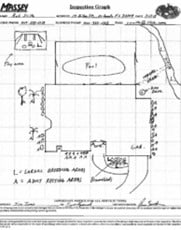
Use the Pest Prevention Graph. When completing your graph, follow these steps:
- At the top of the form, complete the Customer’s name and address.
- Draw to scale the home and the areas of trees and shrubs around the home and perimeter of the yard. These will be the target sites for the mosquito control treatments.
- Outline and measure the perimeter of the home’s linear feet of foundation including where plant beds and other foliage exists.
- Draw the outer boundary of property and boundary barrier area of vegetation, to include the areas, around and up the fence-line.
- Draw all remaining plant beds and foliage on the property.
- Identify sources of mosquito activity in the appropriate spot on the graph. Using L for larval breeding sites and A for adult resting sites.
- Indicate any conducive conditions in need of attention on the graph. Use arrows if necessary to help pinpoint the areas. Areas to record should include:
- Semi- permanent areas holding or having the potential to hold standing or stagnant water such as gutters, gutter drain pans, flat roofs, cans, pots or other containers, tires, tree holes etc.
- Permanent bodies of water such as ponds, lakes, bird baths and small unchlorinated wading pools. Check these areas carefully for larval development. Note all bodies of water where larvae are breeding on the property.
- Potential adult mosquito resting sites on the property: This would be any area that shielded from the wind (i.e., within thick vegetation, behind vegetation on the side of the home, under decking, under or behind tables and barbecues, inside pet houses and under children’s outdoor play equipment, etc.)
- Potential adult mosquito entry points to indoors/porch areas: This includes open windows, torn screens, poorly fitting screen doors, bent window screens etc.
- Calculate the total square footage of the customer’s lot or area to be treated. Refer to the Rate Card to determine the initial and recurring charges. We have three service plans that distinguish Massey Services from the competition. The service programs and prices are adjusted based on the square footage of the property or area being protected.
- The Standard Package includes mosquito control applications (residual & insect growth regulator combination) along with placement of a biological control device, currently an In2Care mosquito trap. Added service time, materials and control devices are required as the lot size increases. The starting Standard Package covers areas less than 3,999 sq. ft.
- The Deluxe Package includes the services and biological control devices described in the Standard Package plus a mosquito trapping device, currently the DynaTrap DT1050 trap. Added service time, materials and control devices are required as the lot size increases. The starting Deluxe Package covers areas less than 3,999 sq. ft.
- The Premium Package includes the services described in the Deluxe Package plus the installation of a mosquito repellent system (Thermacell LIV). Added service time, materials and control devices are required as the lot size increases. The starting Premium Package covers areas less than 3,999 sq. ft of lot size. The number and placement of repellent emitters is based on the area to be specifically protected.
- Thermacell LIV stand-alone package will include a Hub and Repeller’s. The number and placement of Repeller’s will depend on the area to be specifically protected.
- Determine the placement of the biological control devices, traps and emitters and indicate their locations on the graph.
- Calculate the cost of the program (Standard, Deluxe, Premium) being purchased by the customer. Add the cost to the rate card.
- Calculate the cost of the exclusionary services like screen repair. Add the cost to the rate card.
- Properties with or adjoining larger bodies of water such as retention ponds, ponds, and ditches, calculate the number of Altosid briquettes or IGR granules to be used each month. Add in the cost on the rate card.
- On the start sheet, write in any notes as to property access, recommended actions that the Customer needs to take to help prevent mosquito infestation and describe and/or indicate areas that will be of regular concern during a monthly treatment program such as: permanent bodies of water, areas needing mowing prior to each service, areas shielded from the wind that will require treatment every time, and adjacent breeding sites on neighboring properties.
- Complete the form by printing your name and dating the form. The graph should now be ready to present to the Customer. Your goal is to produce a graph that presents a clear picture to the Customer of the yard, sources of mosquito activity, and the mosquito-conducive situations.
- If the Customer wishes a Special Event Treatment, note the area(s) where the main event(s) will occur. The date of the event will be listed on the Agreement.
- Have the Customer sign the form after reviewing the graph and give the Customer the appropriate copy.
- Note large stagnant bodies of water nearby such as retention ponds and non-stocked ponds for stocking with Gambusia mosquito eating fish. Consult HOA, Property Management group regarding this recommendation.
These services reduce the buildup of mosquitos outside the home. This reduction enhances the customer’s use of outdoor areas around their home and reduces the threat of mosquito-borne diseases, protecting public health.
NOTE: Treatments DO NOT CONTROL no-see-ums or false mosquitoes (midges).