OVERVIEW #
The protocol will provide an overview of mosquito biology, common diseases transmitted by them, our treatment protocols, and the required equipment.
IDENTIFICATION #
Mosquitoes are classified in the order Diptera, commonly referred to as flies. Adults of this order have two main wings hence the Latin name Diptera, di meaning two and ptera meaning wing. In addition to the two main wings, flies also possess a pair of very tiny wings called halteres that are used to guide the fly in flight. These rudder-like wings allow the insect to perform abrupt maneuvers.
There are dozens of fly species in the order Diptera. Mosquitos, crane flies, love bugs, fruit flies, house flies, midges, false mosquitos, no-see-ums, and horse flies are all separate families of flies within the order. Mosquitos are in the Diptera family Culicidae. Important distinguishing characteristics of this family are:
- General size and shape
- Scales on wings of adults
- Long proboscis on adults
- Aquatic larval stages that develop and attach at the surface of the water.
HEALTH IMPORTANCE #
Mosquitos “bite” by penetrating the skin with their proboscis and injecting an anticoagulating saliva, these actions can cause skin irritation. In some cases, these bites cause pain, welt up, become red in the immediate area, itch and/or become infected. Some people have allergic reactions to the bites. Diseases obtained from blood meals taken from other animals can be spread to humans when mosquitoes take a human blood meal. Cases of mosquito borne diseases such as encephalitis and West Nile Virus have been on the rise and constitute a serious public health threat.
Mosquitos function as vectors of numerous diseases of man. The following is just a brief list of some of the diseases that can be transmitted. The scientific name for the mosquito responsible for transmitting the disease is in parenthesis.
- Zika Virus: (Aedes aegypti & Aedes albopictus)
- Yellow Fever: (Aedes aegypti & Aedes albopictus)
- Dengue Fever & Chikungunya: (Aedes aegypti & Aedes albopictus)
- Malaria: (Anopheles)
- Eastern Equine Encephalitis: (Coquillettidia & Culiseta)
- St. Louis Encephalitis: (Culex nigripalpus & other Culex)
- West Nile Virus (Assumed to have the same mosquito vectors as St. Louis Encephalitis)
BIOLOGY #
All flies develop through complete metamorphosis. This means that mosquitos go through four life stages, egg, larva, pupa, and adult. These four stages are depicted in Figure 1. Eggs can be laid singly or in clusters (commonly referred to as rafts), deposited in water, on the sides of containers where water will soon cover them or on soil that will soon be moistened by rain.
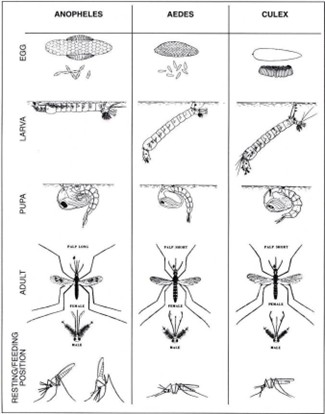
Once enough moisture surrounds the egg for a specific period and at a high enough temperature, the egg will hatch into a larva. The larva is strictly aquatic and feeds on very small aquatic animals, other mosquito larvae, algae, and organic particles by the brushing action of “mouth brushes.” These hair-like combs surround the mouth opening. They are seen in Figure 1 as a tiny dark cluster of hairs on the end of the head (bottom of the picture). At the top end of the larva is a siphon or breathing tube that just breaks through the top of the water to obtain oxygen. If a larva is disturbed it can rapidly wiggle downward. Typically, a larva will molt four times before becoming a pupa and take 7-10 days to complete development, but some species may require several months. Most mosquito larvae breathe air through the breathing tube at the surface of the water.
The larva develops into a non-feeding pupa. The pupa stays at the top of the water breathing through structures on its thorax. These small tubes, respiratory trumpets, can be seen as tiny attachments above the thorax to the top of the water in Figure 1. If the pupa is disturbed it will dive with a tumbling motion and then slowly float to the surface. The pupal stage lasts for 3-4 days, but in some species, it can last for over a month.
The adult mosquito will emerge from the pupal casing, rest on the floating pupal skin to dry its wings and fly away. The time from egg to adult varies by species and is influenced by temperature but can range anywhere from 6 days to 21 days. Regardless of the species it is important to remember that mosquitos have a rapid rate of development and in just a few weeks a huge population of adults can suddenly appear.
Adult male and female mosquitos will then mate, and the females begin to develop eggs. The antennae of males are very feathery (plumose) while female antennae are not as plumose. Female mosquitos bite and feed on blood meals from mammals. Adult males do not bite, feeding on nectar. Male mosquitos are short-lived with a life span of about a week or less. Females can live much longer, averaging 2-4 week.