Introduction #
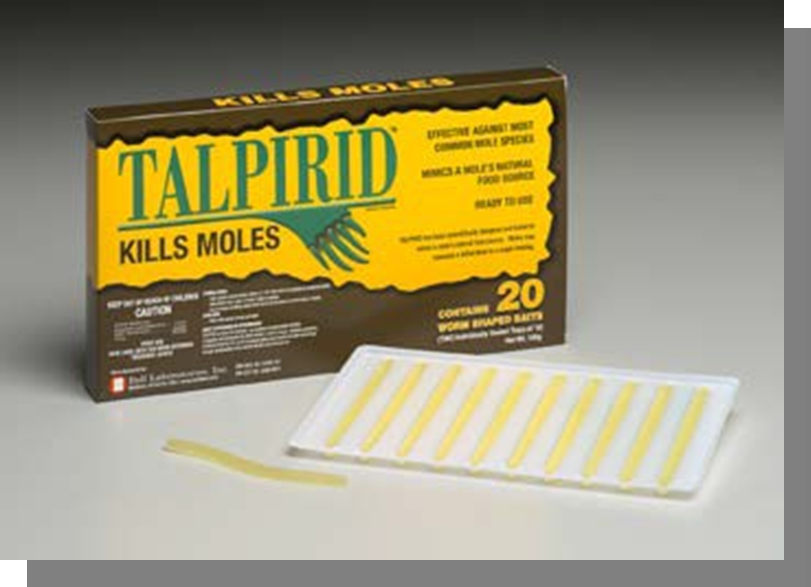
Talpirid is a mole bait that was created by making an attractive gummy worm resembling an earthworm, the mole’s favorite food. The Talpirid “worm” contains a chicken-based bait mixed with 0.025% Bromethalin, a rodenticide.
Control of a mole in its run is accomplished by careful placement of a worm into the run, so it lies on the bottom of the tunnel while the top of the tunnel where the worm was dropped in is re-sealed. Read the Talpirid label prior to use.
Protocol #
- Locate all the mole runs in the yard. These are areas of soil/turf that are humped up and tunnel like.
- Mark the main runs with a marker such as a flagged stake or brightly colored golf tee
- Determine which runs are active:
- Either poke finger-size holes with a dowel into the top of the runs every 5-10 feet or,
- You can also step on all raised runs so that all soil/turf is stomped down and firm on the ground…mark the runs or the holes you made with the flags or tees
- Wait 24-48 hours and poked holes will be sealed back up or stomped ground will be raised again
- Either of these procedures will best identify active mole runs to bait so that Talpirid “worms” are not wasted in old unused runs.
If you must bait immediately without returning, bait the runs without stepping down on any raised soil using the procedure outlined below. Look for the runs with raised surface soil that have cracks in the surface soil. These are generally the most recent runs.
Baiting Procedure for Mole Runs With Talpirid #
Once active runs have been located, use a wood dowel, about ½ to ¾ inches in width to prepare a hole into a mole run for insertion of a Talpirid “worm”.
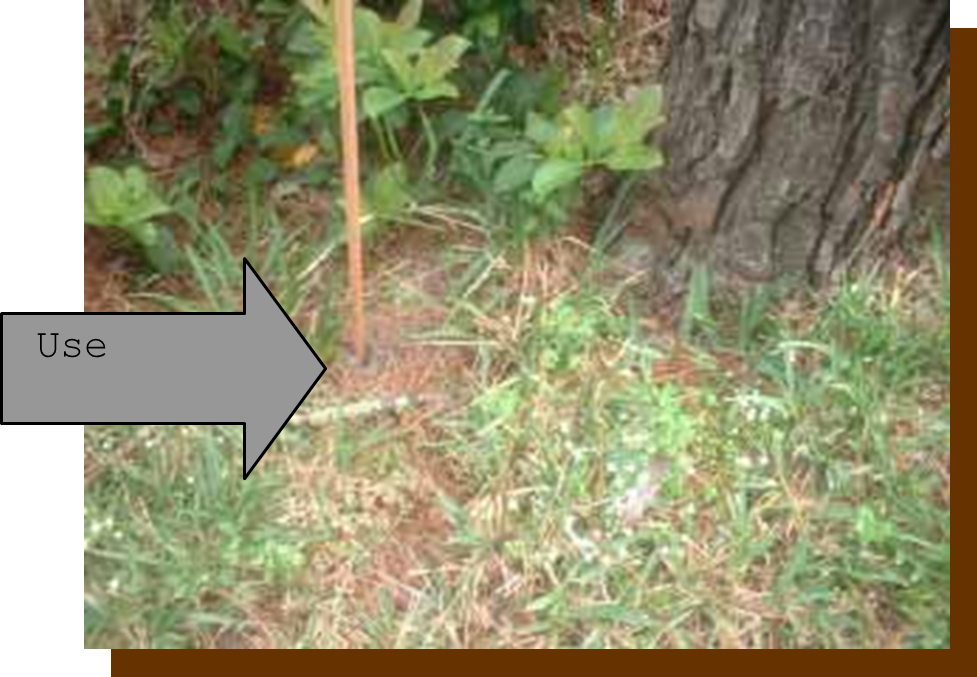
- Push the dowel down into a raised portion of the runway and it will finally hit the hard bottom of the runway and stop. With the end of the dowel resting at the bottom of the runway slowly move the dowel in a circular motion to widen the hole at the top of the ground to finger width.
- Carefully remove the dowel without letting dirt or debris drop into the hole.
- Carefully feel into the runway to ensure that sandy soil has not dropped in or blocked the runway in either direction. When you are sure the runway is clear, insert an entire Talpirid “worm” carefully into the hole.
- MAKE SURE TO WEAR GLOVES! MOLES WILL NOT EAT BAIT IF YOUR SKIN TOUCHES THE BAIT!!
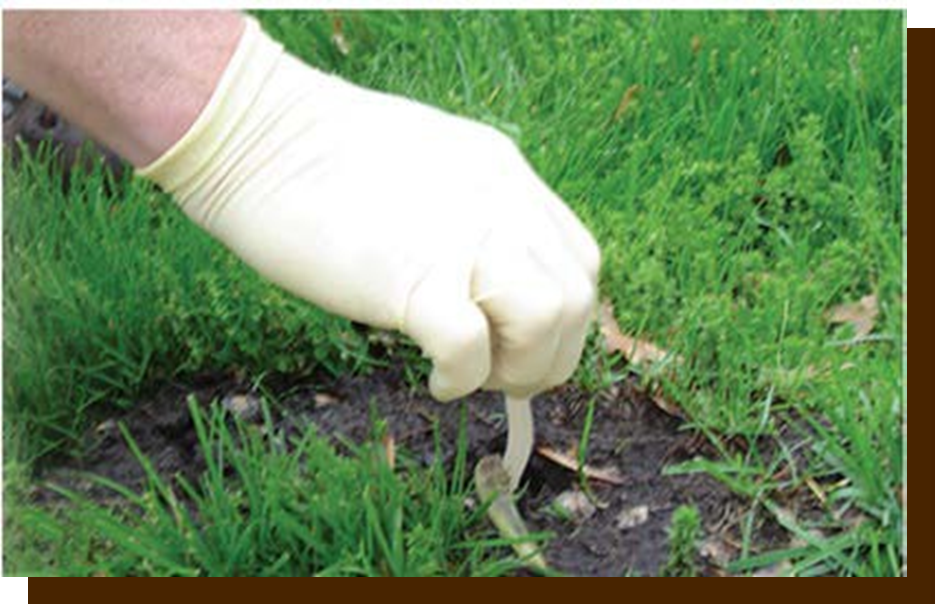
- Keep minimal dirt and debris from clinging to the worm. With the dowel or your finger nudge the worm so that it is laying flat along the base of the runway.
- Seal the hole you made by placing a leaf or two carefully into the hole and pressing them slowly about halfway down towards where the “worm” is lying so that the hole you made is now completely blocked off. Try not to push or dislodge any soil that might drop over the worm. Then place soil over the leaves you pushed in and gently tap over the top of where the hole entrance once was, and you are now finished. Do not press down firmly on this spot with your shoe to seal it by crushing the soil down over the “worm”.
- Worms should never be placed above ground.
- Repeat this procedure every 3 feet of recently raised runway.
- Once “worms” are all placed, wait about a week to 10 days.
Expectations and Follow-Up #
- Runways will be rebuilt on a regular basis, as the Talpirid will only provide temporary control. Damaging tunnels will only be reduced and will rarely be eliminated. Tunnels may appear in new areas.
- Repeat this procedure on newly built runways on a regular basis until the number of runways is reduced.
- Once reduction is achieved, repeat regularly as new runways appear.
- Extend treatments to neighboring areas to reduce the chance that moles will be able to work their way back to the originally infested areas.
- If the customer has dogs, ensure that the dogs do not dig up the worms and eat them. If dogs are diggers, keep them away from the treated areas.
- Sometimes armadillos will dig up the “worms”. If a large number of worms have been placed, there may be enough to kill an armadillo.
- Talpirid “worms” are heat sensitive and can melt, even in a warm toolbox. Store packs in an air-conditioned room and take the bait to the field only on the day of use.
Notes: #
- Talpirid achieves partial to complete control on a short-term basis and should be inspected and rebaited weekly for the best results. Cost for the amount of product used is generally high and often exceeds $15 of material for a yard. From 2+ years experience in Florida of monthly baiting across an infested yard only partial reduction was ever achieved as moles will continuously burrow in from neighboring areas.
- Use of any bait in-ground always allows a chance for dogs to dig and locate it. Ensure no dogs at a home ever have access to a yard that has been baited for moles or we could be paying for a big vet bill or pet replacement.
- From the above experiences, the safest and most effective control of moles remains physically trapping them with a mechanical mole trap such as Bell Labs Talpirid Mole Trap on a run-by-run basis which is also an ongoing process of constant trapping as new mole runs will generally appear every 7-10 days in mole-infested neighborhoods.